bruce price
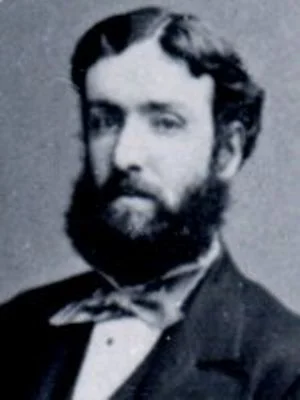
Despite not spending a significant portion of his life in Luzerne County, Bruce Price made a huge impact on the area’s architectural history. Born in 1845 in Cumberland, Maryland, Price learned his life’s work through experience, as he was unable to complete his formal education at Princeton. He interned with Baltimore architects John Rudolph Niernsee and James Crawford Neilson, and later partnered with Ephraim Francis Baldwin to establish the firm Baldwin & Price. After a short study trip to Europe, Price relocated to Wilkes-Barre.
The erratic, yet elegant, Price married Josephine Lee, the daughter of a Wilkes-Barre coal baron, in 1871. From 1873 to 1876, Price was Wilkes-Barre’s most prolific architect, operating from his shop on South Franklin Street. He supplied designs for countless homes and public buildings in Wilkes-Barre, which were in high demand during the city’s massive population boom following the Civil War. Two of his greatest designs, Bedford Hall at Wilkes University and First Methodist Church on North Franklin Street, still stand today. He also designed homes for notable citizens like Lee Bennett and Andrew McClintock.
The most recognizable residential designs by Price were the dozens of cottages built in the gated village of Tuxedo Park, New York. The cottage of Tuxedo Park developer Pierre Lorillard IV was perhaps the grandest of those designed by Price, though famous personalities like Mark Twain and J.P. Morgan were also known to stay at the Price-made cottages. The so-called Bruce Price Cottage, also located in Tuxedo Park, was the temporary residence of Price and his family.
Price’s work in Tuxedo Park and elsewhere was highly influential in the development of Modernist architecture and its leaders, including Frank Lloyd Wright. Price himself was a proponent of many architectural styles, including the Neoclassical, Gothic, and Romanesque styles. He deliberately wanted his buildings to be picturesque, colorful, and natural, making him a perfect match for the Shingle style he helped to establish.
Following his time in Wilkes-Barre, Price moved his base of operations to New York, where he made his mark on the Manhattan skyline. He designed the American Surety Building — the second tallest building in the city at the time of its completion — and the St. James Building, a longtime hub of architectural culture. Price’s innovations in designing skyscrapers anticipated metropolitan zoning regulations that became the standard decades after his death. Other projects in New York that are attributed to Price include the Richard Morris Hunt Memorial in Central Park and the Coryell Apartment Building on 21st Street.
Outside of New York, Price developed many designs for buildings in the New England region, especially in Maine and Connecticut. His designs include The Turrets in Bar Harbor, the Sterling Homestead in Stratford, and Welch Hall on the campus of Yale. Price is also responsible for the designs of the Audrain Building in Rhode Island and the Old Washington County Library in Maryland.
Price designed and patented a bay window parlor car for the Pennsylvania Railroad in the 1880s, which brought him to the attention of the Canadian Pacific Railway executives. They chose Price to design multiple structures in Canada, including Windsor Station and Place Viger in Montreal. Price’s most famous work was among these Canadian designs, as his Château Frontenac in Quebec City is one of the most photographed hotels in the world and a Canadian national landmark.
Price was a well-respected figure in architectural circles, having served as a Fellow of the American Institute of Architects and a member of the Architectural League of New York. He was also the director of the Municipal Art Society of New York. In 1900, Price partnered with French architect Jules Henri de Sibour, though their partnership was cut short when Price died in 1903 at age 57.
Though he died in Paris, Price was buried back in Wilkes-Barre in Hollenback Cemetery. Perhaps his greatest legacy is his daughter, the writer Emily Post, who grew up to become the nation’s leading authority on etiquette. Otherwise, the work of Bruce Price in Luzerne County is kept alive through those who still call the structures he designed their homes.