Jack Palance
Class of 2023
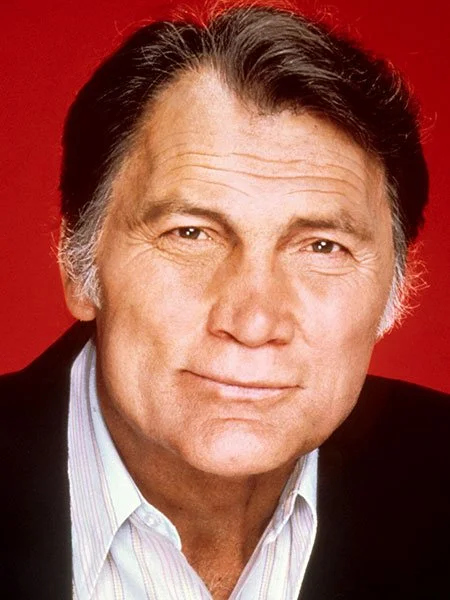
Jack Palance was born Volodymyr Pahlaniuk in 1919 in Lattimer Mines, a small village in southern Luzerne County just outside of Hazleton. Like his father before him, Palance worked in the mines during his youth, but his ambitions were sky high. He earned a football scholarship to the University of North Carolina at Chapel Hill and even fought briefly as a professional boxer.
These athletic dreams were put aside for one reason or another by the time Palance left to fight in World War II. Still, there’s no doubt that his rough-and-tumble youth and his military service impacted the performer he would become. Disillusioned with a path that would require taking constant physical hits, Palance set his sights on becoming a thespian.
In pursuit of this new profession, Palance dropped out of college and headed to New York. His Broadway debut came in 1947 as a Russian soldier, an ironic coincidence considering Palance was of proud Ukrainian descent. His big break on Broadway, however, was not in a starring role. Palance worked as an understudy to Marlon Brando in the initial run of A Streetcar Named Desire. Echoing Brando’s path, Palance made his transition to film in 1950.
After making his screen debut in Elia Kazan’s Panic in the Streets, Palance bounced back and forth between Hollywood and Broadway. But in 1952, Palance scored what would be the role of a lifetime for most other actors, a pivotal part opposite Joan Crawford in the cutting-edge thriller film Sudden Fear. For this role, in which he played a former coal miner who becomes an actor, Palance nabbed his first Academy Award nomination for Best Supporting Actor.
It didn’t take long for Palance to return to the Oscars’ red carpet, as he was nominated again in 1953 for playing the villainous Jack Wilson in Shane, considered by many to be the finest western picture ever made. The role was perfect for Palance; steely-eyed and vicious, Jack Wilson became the part for which he was most known for decades.
As the 1950s waned and the film industry changed, Palance began to work in the growing television scene. In 1956, Palance again drew from his past experiences and won an Emmy for playing a boxer, Mountain McClintock, in the Playhouse 60 production of Rod Serling’s Requiem for a Heavyweight. In 1960, Palance became one of the first celebrities to receive a star on the Hollywood Walk of Fame.
In subsequent decades, Palance worked stateside and internationally with some of the greatest actors and directors of all-time, from Anthony Perkins and Jean-Luc Goddard to Paul Newman and Omar Sharif. Palance gained a reputation for being a sought-after character actor across the globe. Along the way, he padded his resume by landing another signature role as the title character in Bram Stoker’s Dracula, the acclaimed made-for-television film from 1973.
Palance enjoyed a full career renaissance and introduced himself to a brand new generation of audiences in the 1980s and 1990s, first as the host of Ripley’s Believe It or Not!, and later in Tim Burton’s screen adaptation of the Batman comics. However, his most important role during this period was as the cowboy Curly Washburn in the 1991 film City Slickers. Palance won an Oscar for his semi-comedic performance in City Slickers, an unconventional choice for the Academy. Upon winning, the 73-year-old Palance delivered one of the most iconic Oscar speeches ever, which he topped with a surprise round of one-armed push-ups.
Palance continued to work into the 21st century, cementing his status as one of the most lasting stars of Hollywood’s Golden Age. All the while, he retained his connection to Luzerne County and could often be spotted at local establishments near his farm in Butler Township, such as the Stagecoach Inn. His knack for playing tough but amusing characters was reflected in his off-screen persona, and his ability to find the intensity, physicality and heart in his characters has entertained movie fans young and old for generations.