Lawrence Russo
Class of 2025
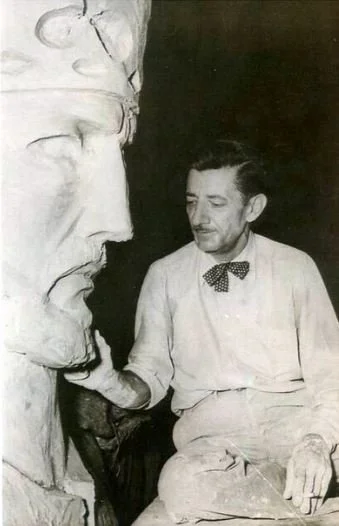
The sculptor Lawrence Russo was born in Solofra, Italy, near Naples, in 1897 and was brought along with his family to the United States as a boy. Raised in Brooklyn, Russo represented the seventh generation of an artistic dynasty. His father, Michael Gaetano Russo, was a renowned sculptor, and is responsible for the Christopher Columbus statue in the center of New York City’s Columbus Circle. Just as his ancestors shaped their surroundings through art, Lawrence Russo would eventually do the same for the Wyoming Valley.
Russo was well-educated, and attended a number of esteemed institutions to round out his artistic background. He studied at the Beausz-Arts Institute of Design in New York, and went on to be a student of architectural design, painting, and drawing at a number of the city’s other cultural and art schools. Following his time as a scholar, he made his way to the Wyoming Valley and settled on the west side of the Susquehanna River.
Over the years, Russo contributed greatly to the artistry of many buildings and monuments in Luzerne County, predominantly through his sculpture work. In the Wyoming Valley, he was responsible for the decorative nature of St. Mary’s Church of the Maternity and St. Patrick’s Church. In the southern half of the county, Russo produced for St. Joseph Church in Hazleton and St. John Bosco Catholic Church in Conyngham. Beyond the borders of Luzerne County, Russo sculpted the Statue of the Sacred Heart at Marywood University.
Russo also did sculpting work for secular institutions, including the Kirby Memorial Health Center and the Plymouth Public Library. Russo’s work is not limited to Northeast Pennsylvania, either; it can be found in other parts of the state, as well as in New York and New Jersey. The most notable of these non-local examples are his enhancements to New York City Hall, and the New York State Capitol building in Albany.
Aside from the buildings that adorn the work of Russo, there are a number of busts and monuments that can claim him as their creator. His war memorial in Sugar Notch is among his most famous pieces, and its unveiling in 1948 was attended by former First Lady Eleanor Roosevelt. A bust of Franklin D. Roosevelt sits atop the war memorial, and Russo’s other busts include those of John F. Kennedy and Pope Pius XII.
Surely the most striking piece by Russo is the “Christ the King” statue on the top of the King’s College Administration Building. Originally designed by Adolph Ell of the college art department, it was Russo who suggested that the towering statue be posed with arms outstretched horizontally, allowing it to more easily withstand harsh winds. Dedicated in 1956, the 1500-pound “Christ the King” remains one of the Wyoming Valley’s iconic images.
In later years, Russo remained active in the community. He was a set designer at the Little Theatre of Wilkes-Barre for decades, and helped to restore 60 portraits and 26 murals in the Luzerne County Courthouse in 1967. Always a friend to aspiring and established artists alike, Russo worked with art students from his studio in Kingston and elsewhere.
Nicknamed “Michelangelo” by his family, Russo’s legacy has been carried forward since his death on February 18, 1969 — the same month and day as the original Michelangelo’s death. Since his passing, Russo’s work has lasted, and an exhibit honoring his creativity was held by the Luzerne County Historical Society in 2013.
It’s rare that an artist outside of the architectural world can say that they have fundamentally changed the skyline of a city. Through the “Christ the King” statue, Lawrence Russo has done just that for Wilkes-Barre. Otherwise, there are a number of pieces throughout Luzerne County that, even if less pronounced than “Christ the King,” are treasures that beautify the area. In many cases, those, too, are the work of Lawrence Russo.