Florence Foster Jenkins
Class of 2025
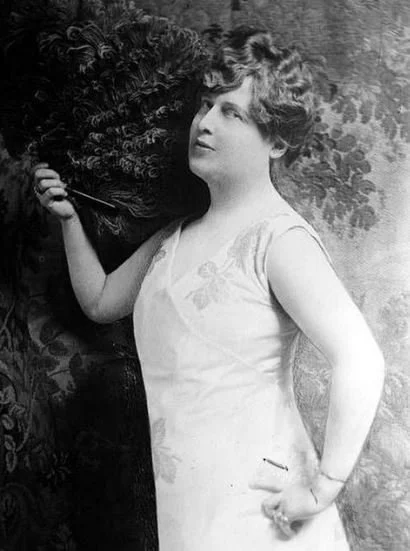
Luzerne County is the one place in the United States that can rightfully claim the incomparable Florence Foster Jenkins as a native daughter. Born Narcissa Florence Foster in 1868 to a wealthy Wilkes-Barre family, she’s known in the modern day as “the world’s worst opera singer.” However, as is the case with many artists’ careers, Jenkins’ story is more complicated than the armchair critics of the past century might have you believe.
In her early years as a pianist, she was known as “Little Miss Foster” and performed in a space that is traditionally reserved for only the most talented musicians. The young Florence performed at the White House during the Rutherford B. Hayes administration, a sign of her child prodigy status. Later, she studied and performed music while a student at the Moravian Seminary for Young Ladies in Bethlehem.
A series of unfortunate events threw a wrench into Florence’s musical life while she was still just a teenager. In her mid-teens, she married a man who was twice her age, and she was stricken with syphilis soon after. Records of the marriage are difficult to track, but the illness and the surname Jenkins stuck with her for the rest of her life. Another health complication came during this era as well, as an arm injury all but dashed her aspirations to be a pianist. Additionally, her father refused to further fund her music career, leaving Florence in a complicated position.
Still, Jenkins remained involved in music by teaching piano to students in Philadelphia. She also developed a relationship with British actor St. Clair Bayfield, who would act as a manager and companion for the rest of her life. Her father’s death in 1909 left Jenkins with significant monetary clout, thus beginning her foray into the New York social scene. Jenkins used her newfound status to continue her music career, taking voice lessons and designing her own costumes for private shows and social events.
Despite her lack of vocal talent — to put it kindly — Jenkins was socially aligned with some of the great voices and musical minds of her day. Some, such as vocalists Enrico Caruso and Geraldine Farrar, were honorary members of the Verdi Club, a social organization founded by Jenkins. Others, such as songwriter and performer Cole Porter, were known to frequently attend her recitals. The marriage of Jenkins’ vocal incompetence and famous fandom made her one of the great musical camp figures of the 20th century’s first few decades.
The elegant “Lady Florence” displayed a great bravery in her vocal work, once saying, “People may say I can’t sing, but no one can ever say I didn’t sing.” She routinely chose difficult pieces to perform, which exposed her struggles with even the most basic vocal techniques. Nevertheless, her most prominent accompanist Cosmé McMoon would often tailor his performances to Jenkins’ unconventional delivery.
There is significant debate as to whether Jenkins was aware of her own voice’s shortcomings. It is often believed that the syphilis she contracted had a direct impact on her voice’s deterioration. At the very least, Jenkins seemed to have had some level of self-awareness, as she kept serious music critics at a distance. Those critics, alongside the guests of a sold-out Carnegie Hall, would finally get their chance to hear Jenkins perform live in 1944.
Jenkins, at age 76, gave a historically panned performance in the iconic New York venue, giving in to years of public pressure to perform for a live audience. The stunning display was watched by admirers and hecklers alike, and the reviews, unsurprisingly, were harsh. Jenkins was surely crushed by the response, and she suffered a heart attack less than a week after the Carnegie curtains closed. Within a month of the heart attack, Jenkins passed away.
Jenkins remains a pop culture icon, and audio and visual recordings of her performances survive to this day, a distinction not shared by many artists of superior technical talent. She has been depicted on stage and screen, most notably in the 2016 film Florence Foster Jenkins, for which Meryl Streep’s portrayal of the titular role was nominated for an Academy Award. Evidenced by the continued interest in her life decades after her death, Jenkins’ one-of-a-kind rise to fame is a story for the ages.