Lyman H. Howe
Class of 2025
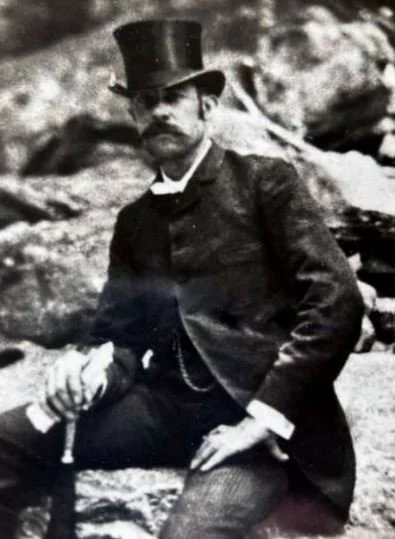
Before the elements of modern movie making became mainstream, there was Lyman H. Howe, a native of Wilkes-Barre. Born in 1856, Howe would help bridge the gap between cinema’s infancy and its rise to relevance in American culture. His experience as a traveling salesman while a young professional lit his entrepreneurial fire, and, from there, Howe became one of the most innovative figures in the turn-of-the-century motion picture industry.
Riding the wave of traveling showmanship that was quite popular in the postbellum United States, Howe entered the entertainment world in 1883. At that time, he purchased a 3000-pound, working model of a coal mine and showed it throughout Pennsylvania and other states. Later, he exhibited the model in Mauch Chunk (modern day Jim Thorpe) in Carbon County during the summer months, and worked as a painter in the winter.
Upon purchasing a phonograph in 1890, Howe showed the machine’s potential to the people of Northeast Pennsylvania. He was among the first people to use a phonograph as a portable concert, and he made the sound more immersive by projecting it with a tin horn. Howe took on a showman’s attitude in his creative appearances, often dubbing himself in promotional materials as a “professor” or “lecturer.” His big personality and fancy attire made him a true entertainer.
After failed attempts at purchasing proto-film projectors like the kinetoscope and vitascope, Howe proceeded to invent a piece of revolutionary film equipment himself: the animotoscope. The piece’s defining feature was its second reel, which allowed for longer films to be shown. Howe first presented a film exhibition to Wilkes-Barre audiences in 1896, and subsequently toured small towns for additional showings. Howe married film to sound by using the phonograph, featuring live music and actors, and occasionally providing spoken commentary to his projections. In doing so, he was one of the first people to use a phonograph to create sound effects in movies.
Howe began making his own films, which consisted mainly of newsreels and travelogues, in 1901. The films were popular commercial successes, and he regularly filled local venues with his presentations. Howe filmed a number of historic Luzerne County events, including President Theodore Roosevelt’s visit to Wilkes-Barre in 1905, and the borough of Wilkes-Barre’s 100th anniversary celebration. In that regard, Howe’s films served both entertainment and educational interests.
At the height of his filmmaking power, Howe controlled six traveling movie companies, all of which were headquartered in Wilkes-Barre. When the earliest movie theaters, referred to as nickelodeons, began springing up in small towns, the Howe business model began targeting audiences in big cities. All the while, Howe retained his local roots, both creatively and socially. He was once the president of the Wilkes-Barre Chamber of Commerce, and became one of the first people to film from a plane, which he did over Kirby Park in 1911.
Throughout the 1910s, Howe was active in the United States and Canada, and his production company continued to capture history across the globe. His output included films about filmmaking itself, the building of the Panama Canal, the wedding of Alfonso XIII of Spain, and various cultures from around the world. While many of his films have been lost, one of his most popular, 1921’s Lyman H. Howe's Famous Ride on a Runaway Train, has been found and is preserved.
Following his death in 1923, Howe’s company and film laboratory survived beyond both him and many of his early competitors. Interest in Howe’s work has fluctuated since, though the documentary Lyman H. Howe's High Class Moving Pictures, a written biography, and continued preservation efforts have kept him close to many a film fan’s consciousness, especially in Luzerne County.
Over the past century, filmmaking has grown into a massive source of artistic expression, but the contributions of Howe have remained critically important to film history. In terms of exhibition and filmmaking processes, his work projected many of the innovations that would guide the destiny of motion pictures. Lyman H. Howe is not only the forefather of Luzerne County’s cinema culture, but an irreplaceable cog in the industry’s development.