Marion Lorne
Class of 2025
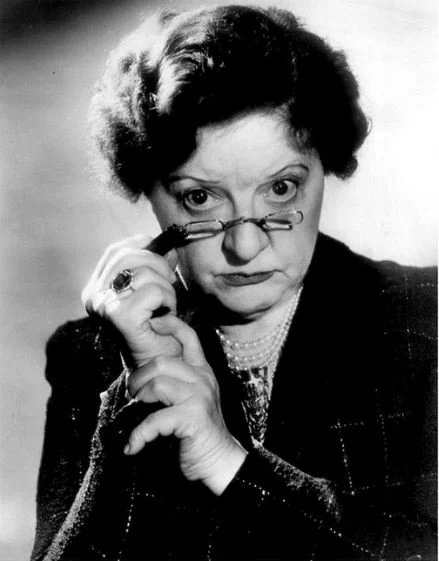
Marion Lorne is perhaps the most successful actress to ever come from Luzerne County, not only due to her incredible longevity, but also to her skill. Over the course of seven different decades in the performing arts, Lorne’s acting chops were intoxicating, and her most iconic role, which came to her late in life, solidified her place in the television industry’s pantheon of iconic supporting characters.
The story begins in West Pittston, the borough that continues to honor her legacy to this day. Born in 1883, Lorne’s early education was based in the West Pittston school system, and she eventually graduated from Wyoming Seminary. She went on to sharpen her theatrical skills at the American Academy of Dramatic Arts in New York City, while interest in Lorne’s progression as a performer remained strong back home in Luzerne County.
Her professional career’s long first act was characterized by notable appearances on both the New York and London stages. She debuted on Broadway in 1905 in the play Mrs. Temple’s Telegram, and in London in He Didn’t Want to Do It, which was co-written by her husband, the playwright Walter Hackett. With Hackett, Lorne helped to establish the Whitehall Theatre as one of the West End’s most prominent bastions of drama.
Hackett and Lorne’s partnership was a prolific one. The Whitehall became their playhouse, and their theatrical collaborations regularly ran for more than 125 nights. Throughout the 1930s, Lorne developed her quirky, and somewhat mischievous, style through her husband’s comedies and mysteries. Upon Hackett’s death in 1944, Lorne returned to the American stage for a five-year run in the production of Harvey as Veta Louise Simmons, a role she reprised in the 1958 television adaptation of the play.
Though Lorne would have a small, uncredited role in the 1931 short film Success, her proper film debut came twenty years later in Alfred Hitchcock’s Strangers on a Train. She also dipped into television work in the early 1950s, most notably in the sitcom Mister Peepers, the show for which she received her first two Emmy nominations for Outstanding Supporting Actress in a Comedy Series.
In the 1950s and 1960s, Lorne became a popular face on the variety and game show circuit, appearing on such staples of early television as The Ed Sullivan Show and I’ve Got a Secret. Additionally, she was a regular on The Garry Moore Show during its first six years on the air. Lorne also starred opposite Joan Caulfield in the short-lived sitcom Sally, for which she garnered her third Emmy nomination.
After making another brief appearance in a cinematic classic — this time in 1967’s The Graduate — Lorne made her way back into television for her most popular role: Aunt Clara in Bewitched. As was the case for many of Lorne’s prior theatrical roles, the eccentric Aunt Clara was a perfect match for her skill set. Peculiarities in the character’s personality, such as her collection of doorknobs, were actually quirks brought to Aunt Clara from Lorne’s own life.
Lorne received another two Emmy nominations for portraying Aunt Clara, though her run on Bewitched was cut short in 1968 when she passed away at 84. On her second nomination for Bewitched, and fifth overall, Lorne captured the win in the Supporting Actress in a Comedy Series category. Her television niece, Elizabeth Montgomery, accepted the award on her behalf. In subsequent episodes of Bewitched, no other actress replaced Lorne in the Aunt Clara role.
Lorne continues to be celebrated in Luzerne County, and especially in West Pittston. In 2023, a film festival was organized by the West Pittston Historical Society in recognition of Lorne’s career, anchored by screenings of her television and movie appearances. The festivities and sheer power of her output have pumped an irreversible local interest into Marion Lorne’s remarkable career.