Niccolo Cortiglia
Class of 2025
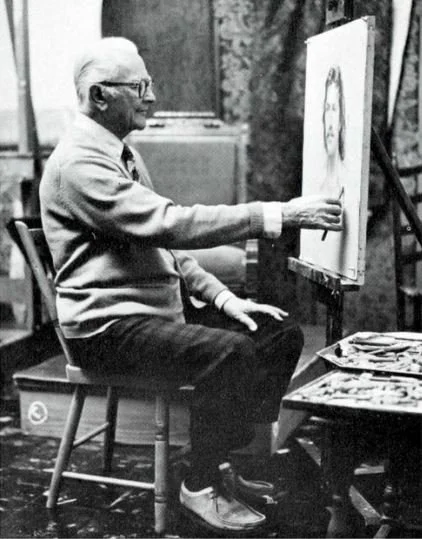
So many of Luzerne County’s current artists can be traced back to the teachings and innovation of Niccolo Cortiglia. After growing up and learning in global artistic hubs in the United States and Italy, Cortiglia came to the Wyoming Valley and changed its arts scene forever. Known for his cheerful outlook, Cortiglia was well-known as an esteemed teacher and artist for the great majority of his long life.
Born in 1893 in New York, Cortiglia was educated well in the ways of artistic expression. He was mentored by the renowned impressionist painter William Forsyth at the John Herron Art Institute in Indianapolis, and later attended the Royal Academy of Fine Arts in Florence, Italy. His work was appreciated by the Italian art world, culminating in the Society of Fine Arts recognizing his “Sphinx” as the body’s favored painting in 1920.
Upon returning to New York, Cortiglia opened an art studio on 16th Street, before relocating to Wilkes-Barre in 1923. “Nick,” as he was locally known, spent the rest of his life in Northeast Pennsylvania. His artistic eye was attracted to the coal breakers scattered throughout Luzerne County, as well as the Susquehanna River. Both features would inform his landscape paintings. In addition, Cortiglia produced campaign posters for the young Community Welfare Federation — now the United Way of Wyoming Valley — for free.
A breakthrough in Cortiglia’s early career came when he was commissioned to paint the wife of Postmaster General Harry S. New. The work proved to be a success, and portraiture became the core of Cortiglia’s artistic output from that point on. On the state level, Cortiglia painted Senator Andrew J. Sordoni, and governors John S. Fine and Arthur James. Cortiglia’s work has been displayed at the State Capitol building in Harrisburg.
Figures of local importance, such as Bishop William Hafey and Admiral Harold Raynsford Stark, who was a Wilkes-Barre native, were also among Cortiglia’s portrait subjects. General Oscar Westover’s portrait by Cortiglia, commissioned by the National Geographic Society, was hung in the Pentagon. Other notable figures painted by Cortiglia were New York Mayor Fiorello LaGuardia, Maine Governor Horace Hildreth, and IBM President Thomas J. Watson.
Cortiglia’s style was both straightforward and highly intricate. He advocated for emphasizing likeness in creating a portrait, and worked to strike a balance between drawing and painting in order to find a more real sense of the person being portrayed. Cortiglia was greatly influenced by both Western and Eastern art movements, and even found an appreciation for contemporary abstract art.
Cortiglia’s legacy as one of Luzerne County’s most distinguished artists has been closely guarded by the many students he taught from the Cortiglia Art School on Franklin Street in Wilkes-Barre. Indeed, many of his lessons remain relevant in the local arts scene thanks to his impressive web of still active students in the region. In 1955, Cortiglia helped to found the Wyoming Valley Art League, further cementing his status as a supporter of future artists.
In addition to his own art school, Cortiglia was a great friend to both of Wilkes-Barre’s colleges. One of his final exhibitions was hosted at the Sordoni Art Gallery in 1977 on the Wilkes University campus. Likewise, King’s College granted Cortiglia an honorary degree in 1978, and the King’s campus is perhaps the best modern showcase of Cortiglia’s work. The coal-themed mural he painted for the college library was considered to be one of his proudest achievements, and many of his portraits of former King’s presidents remain on display in the main hallway of the college’s Administration Building.
Cortiglia’s work is respected throughout the country and the world, especially in Luzerne County, New York, the American Midwest, and Italy. Prior to his death at 89 in 1982, Cortiglia’s work was given its flowers in these areas and more, demonstrating his worldwide appeal and broad artistic sensibilities. Most importantly, thanks to Cortiglia’s lessons over decades of teaching, his approach will remain at the core of Luzerne County’s culture.